
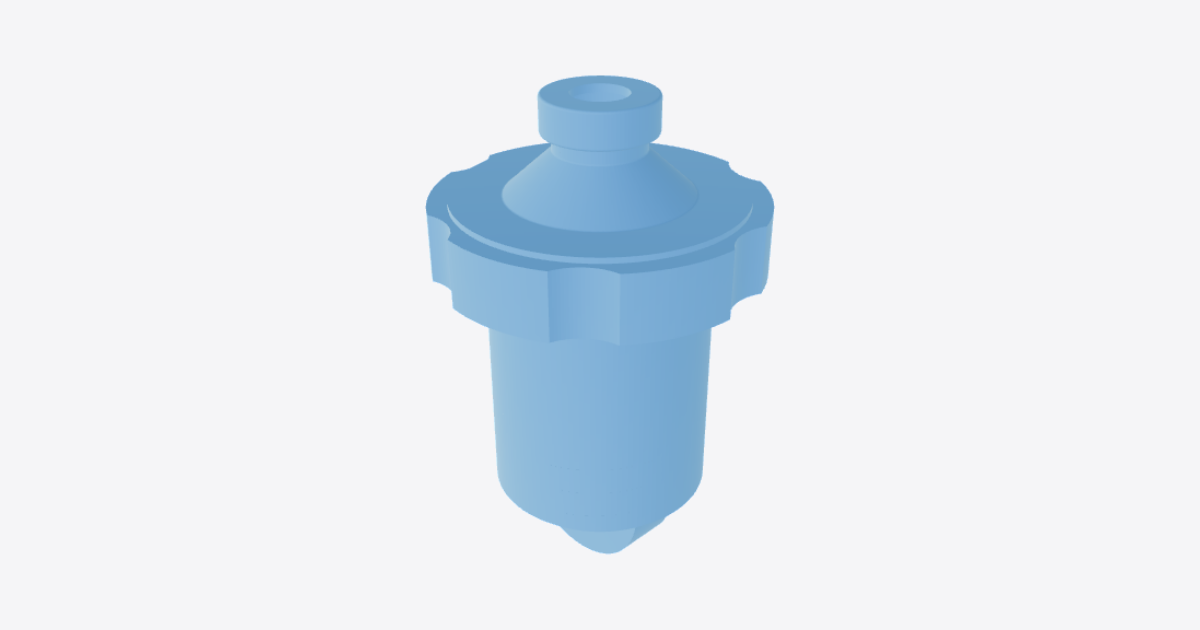
Make and fill the filter
Warning: This carbon filter does NOT remove bacteria or viruses. It is not a certified drinking-water device. Always also remove germs with an effective separate treatment.
9 steps
Understand the filter's safety limits
Build the Open Source 3D Printed Water Filter by the Faircap team, Mauricio Cordova / Makerboat, described in the public-domain CC0 Instructables guide.
This carbon filter does NOT remove bacteria or viruses. It is intended only to improve taste and reduce some chemicals and particles. It is not a certified drinking-water device.
Always use a separate, effective germ-removal treatment. Use a cartridge rated for the organisms present; an ultrafiltration cartridge must not be assumed to remove viruses unless specifically rated for them. Alternatively, bring water to a rolling boil for 1 minute, or 3 minutes above 2,000 m elevation, and let it cool in a clean, covered container. For SODIS in a suitable clear bottle, use a validated protocol: typically at least 6 hours in strong sunlight or 2 consecutive days in cloudy conditions. Do not rely on 4 hours of sunlight.
Salt soaking and rinsing charcoal does not demonstrate activation or chemical-removal performance. Do not use this filter to make chemically contaminated water safe.
Print the two housing parts
Print the cap-and-tube part and the bottom cap in food-grade PET filament. Keep the bottom cap separate so the tube remains open for filling.
Food-grade filament alone does not establish that the finished print is safe for repeated drinking-water contact.
Crumble additive-free charcoal
Crumble campfire or barbecue charcoal that contains no additives such as lighter fuel. Prepare this material separately from the filter housing.
This preparation produces charcoal filter media, not verified activated carbon. Avoid breathing charcoal dust.
Soak the charcoal for 24 hours
Soak the charcoal for 24 hours in salt water made with 25% salt and 75% water. Keep the material outside the filter during soaking.
This salt-soaking process does not establish that the charcoal has been activated.
Rinse the charcoal
Rinse the charcoal in clean water for about an hour. Change the water repeatedly to remove the salt. Do not taste the charcoal or rinse water to assess salt removal.
Insert the cotton pad at the nib end
With the bottom cap still off, push a cotton pad through the open bottom of the cap-and-tube part. Seat it at the very top inside the cap, at the nib end.
Fill the tube with carbon media
Keep the cotton pad seated at the nib end. Fill the rest of the tube with the rinsed carbon media, leaving the bottom-cap threads clear.
Screw the bottom cap into the tube
Screw the bottom cap into the tube to retain the carbon media. Engage the threads without cross-threading and tighten by hand.
Attach to the jug and pour through the nib
Screw the filled filter's cap-and-tube part onto a 5 to 8 litre water jug with a matching standard neck thread, 38 mm inner and 44 mm outer. Engage the threads without forcing them.
Pour the water out through the nib into a clean container. Apply the separate germ-removal treatment described in the first step before drinking, and keep treated water protected from recontamination.